
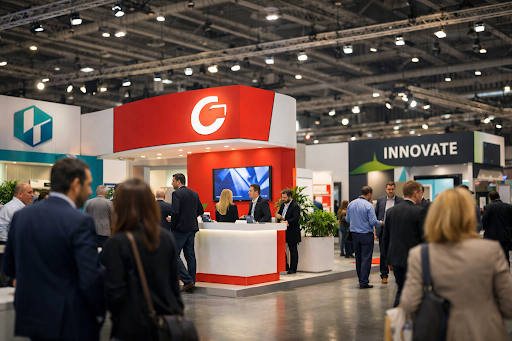
A trade show is a live environment, not a controlled rollout. Visitors often make quick judgments, sometimes in just seconds, before moving on. That immediacy is exactly why exhibitions can be one of the most powerful places to launch a new brand identity, when the strategy behind it is clear.
This is not about unveiling a logo on a backdrop. It is about turning a new identity into something people can experience, understand and remember in minutes. When done well, a trade show forces a brand identity to function under real scrutiny, where clarity and confidence are tested immediately. It becomes tangible rather than theoretical.
Why trade shows are a high-impact moment for a new identity
Trade shows gather people who are already open to engagement. Visitors arrive expecting to discover, compare and evaluate. That makes exhibitions a strong environment for repositioning or relaunching a brand, particularly when clarity matters, and competition is close by.
Unlike digital channels, exhibitions allow full control of the environment. Layout, materials, lighting, sound and behaviour all contribute to perception. A new identity can be expressed spatially, as well as visually.
For a launch, this matters. In live settings, visitors tend to recall how a space felt and how a conversation unfolded, rather than specific visual elements in isolation.
Get the brand story sharp before you touch the stand design
A new brand identity will not survive a trade show if the underlying story is unclear. Exhibitions expose weak thinking quickly because visitors ask direct questions and expect clear answers. In practice, this often shows up as hesitant conversations, mixed messages across stand graphics, or visitors asking for clarification instead of engaging.
Before any design work begins, align internally on what has changed and why. This starts with clear brand positioning, which defines how you want to be understood and why you are different. Without this foundation, even polished visuals can feel cosmetic. If you need to pressure-test that foundation, this guide to brand positioning explains why clarity at this stage shapes every touchpoint that follows.
Treat identity as a system, not a set of assets
Brand identity is more than a visual refresh. It is the combination of visual language, tone, values and behaviour that shapes how a business is recognised and remembered. At a trade show, any disconnect between what the stand looks like and how the brand behaves is immediately visible. When identity is treated as a system rather than a collection of assets, the experience feels deliberate and credible, even under pressure.
This is where considered brand design plays a critical role, ensuring visual language, messaging and behaviour work together in real-world settings.
Set launch goals that go beyond lead numbers
A trade show rebrand is not only a sales exercise. It is also a perception shift. Success should be measured accordingly, especially when the goal is recognition and confidence, not just volume.
Strong launch indicators often include:
-
- Visitors can describe what is new without prompting
-
- Conversations feel more focused and confident
-
- The stand attracts the right audience, not just footfall
-
- Follow-up conversations are easier because the story is clearer
-
- Recognition carries over after the event
Matching identity ambition to exhibition outcomes
| Launch aim | Visitor response to look for | Stand design focus |
| Premium repositioning | Confidence and trust | Quality materials, calm layout |
| Market expansion | Reassurance and clarity | Simple value statements |
| Modernisation | Energy and relevance | Movement and interaction |
| Sustainability-led shift | Credibility | Reusable, transparent systems |
Design the stand as the identity in three dimensions
The most common failure in trade show rebrands is treating the stand as a display rather than an expression. A new identity needs to shape how people move, pause and interact. This is a pattern that shows up repeatedly at events: stands can look impressive from the aisle, but if the experience is unclear, the conversations do not land.
Use layout to guide behaviour
A well-designed launch stand should make it obvious where to enter, where to engage and how to move on. Flow supports conversation. Congestion kills it.
Effective identity-led stands typically include:
-
- A clear visual invitation from the aisle
-
- A focal point that communicates the “new” instantly
-
- Defined areas for conversation without blocking movement
-
- A natural exit that leads to the next step
This is where specialist expertise matters. If the goal is to launch properly, the exhibition stand must be designed to express the identity, not simply house it.
Prepare your team to carry the identity
People complete the brand experience. A strong identity can be undermined quickly if the team on the stand lacks clarity or confidence.
Every team member should understand:
-
- What has changed
-
- Why has it changed
-
- How to explain it simply
Tone matters as much as content. A modern identity should not be delivered in a cautious or dated way. Visitors notice when the environment suggests confidence, but the conversation suggests uncertainty.
A loose conversational structure helps maintain consistency without sounding scripted:
-
- Context first
-
- The shift or evolution
-
- Relevance to the visitor
-
- Clear next step
Create a launch moment with intent
A trade show launch should feel planned, not accidental. That does not mean spectacle for its own sake. It means choosing when and how the identity is revealed or explained.
Atmosphere plays a role here. Lighting changes, sound cues or subtle visual transitions can all signal that something new is happening. This aligns closely with the thinking behind creating memorable events, where intent and environment shape recall.
Capture proof and momentum while it is live
A rebrand launch creates content by default. Use it, but keep it purposeful.
Capture:
-
- Short stand walkthroughs
-
- Detail shots of materials and finishes
-
- Visitor reactions and questions
-
- Clear explanations of what is new
This material reinforces the identity after the event and helps keep your rollout consistent across future touchpoints.
Carry the identity forward after the show
A trade show is the first public chapter, not the conclusion. Use feedback and observation to refine messaging and presentation. If a particular phrase consistently confuses visitors, adjust it. If one visual cue consistently attracts attention, build around it.
Anchoring the new identity in real-world delivery builds trust. Pointing people to completed exhibition projects shows the brand is not theoretical. It has been built, experienced and tested across different contexts.
The key takeaway is
If you want to know how to launch a new brand identity at a trade show, treat it as a live test of clarity. Build the story first, design the environment to express it, and prepare the people who will bring it to life.
When those elements align, a trade show becomes more than a reveal. It becomes the moment the new identity starts being recognised for what it is now. If you are planning a rebrand launch and want it to land with real impact, explore our exhibition stand design approach and start shaping a space that supports confident conversations, not just good photos.